<?xml version="1.0" encoding="utf-8"?><feed xmlns="http://www.w3.org/2005/Atom" ><generator uri="https://jekyllrb.com/" version="4.3.2">Jekyll</generator><link href="http://localhost:4000/feed.xml" rel="self" type="application/atom+xml" /><link href="http://localhost:4000/" rel="alternate" type="text/html" /><updated>2023-02-27T14:26:29+01:00</updated><id>http://localhost:4000/feed.xml</id><title type="html">Georg Böcherer’s Blog</title><subtitle>On this website, I publish blog posts about my research on telecommunications.</subtitle><entry><title type="html">Talks</title><link href="http://localhost:4000/talks/" rel="alternate" type="text/html" title="Talks" /><published>2023-02-16T00:00:00+01:00</published><updated>2023-02-16T00:00:00+01:00</updated><id>http://localhost:4000/talks</id><content type="html" xml:base="http://localhost:4000/talks/"><![CDATA[<ul>
  <li>F. Diedolo, G. Böcherer, M. Schädler, S. Calabrò <a href="/diedolo2022nonlinear_slides.pdf">Nonlinear Equalization for Optical Communications Based on Entropy-Regularized Mean Square Error</a>, joint lab workshop 2022, Munich.</li>
  <li>G. Böcherer, <a href="/bocherer2019integration_slides.pdf">Integration of Probabilistic Shaping and Forward Error Correction: Spectral Efficiency, Rate, Overhead</a>, CNRS/GdR ISIS Workshop on Coding, Modulation, and Signal Processing for Optical Communications, Telecom Paris Tech, Paris.</li>
  <li>G. Böcherer, <a href="/bocherer2018joint_slides.pdf">On Joint Design of Probabilistic Shaping and Forward Error Correction for Optical Systems</a>, OFC 2018, San Diego.</li>
  <li>G. Böcherer, <a href="/bocherer2017information_slides.pdf">Information-Theoretic Benchmarks for Coded Modulation</a>, habilitation lecture, <a href="http://www.tum.de">TUM</a>, October 9, 2017.</li>
  <li>G. Böcherer, F. Steiner, P. Schulte <a href="/bocherer2017fast_slides.pdf">Fast Probabilistic Shaping Implementation for Long-Haul Fiber-Optic Communication Systems</a>, ECOC 2017, Gothemburg.</li>
</ul>]]></content><author><name></name></author><summary type="html"><![CDATA[F. Diedolo, G. Böcherer, M. Schädler, S. Calabrò Nonlinear Equalization for Optical Communications Based on Entropy-Regularized Mean Square Error, joint lab workshop 2022, Munich. G. Böcherer, Integration of Probabilistic Shaping and Forward Error Correction: Spectral Efficiency, Rate, Overhead, CNRS/GdR ISIS Workshop on Coding, Modulation, and Signal Processing for Optical Communications, Telecom Paris Tech, Paris. G. Böcherer, On Joint Design of Probabilistic Shaping and Forward Error Correction for Optical Systems, OFC 2018, San Diego. G. Böcherer, Information-Theoretic Benchmarks for Coded Modulation, habilitation lecture, TUM, October 9, 2017. G. Böcherer, F. Steiner, P. Schulte Fast Probabilistic Shaping Implementation for Long-Haul Fiber-Optic Communication Systems, ECOC 2017, Gothemburg.]]></summary></entry><entry><title type="html">Teaching</title><link href="http://localhost:4000/teaching/" rel="alternate" type="text/html" title="Teaching" /><published>2023-02-16T00:00:00+01:00</published><updated>2023-02-16T00:00:00+01:00</updated><id>http://localhost:4000/teaching</id><content type="html" xml:base="http://localhost:4000/teaching/"><![CDATA[<h1 id="machine-learning-for-communications">Machine Learning for Communications</h1>
<p>Teached as one semester course at <a href="http://www.tum.de">Technical University of Munich</a> since 2020.</p>

<p><a href="/mlcomm.pdf">Lecture Notes on Machine Learning for Communications</a></p>

<h1 id="channel-coding">Channel Coding</h1>
<p>Teached as one semester course at <a href="http://www.tum.de">Technical University of Munich</a> from 2013-2015.</p>

<p><a href="http://arxiv.org/abs/1607.00974">Lecture Notes on Channel Coding</a>.</p>

<h1 id="coded-modulation">Coded Modulation</h1>
<p>Teached as short course Fundamentals of Bit-Interleaved Coded Modulation at NCTU, Taiwan. Teached as one semester course <a href="http://www.lnt.ei.tum.de/en/teaching/lectures/coded-modulation/">Coded Modulation</a> at <a href="http://www.tum.de">Technical University of Munich</a> since 2014.</p>

<p><a href="/bocherer2018principles.pdf">Principles of Coded Modulation</a>.</p>

<h1 id="variable-length-coding">Variable Length Coding</h1>

<p>Teached as short course <em>Kodierung mit variabler Länge: Datenkompression und Verteilungsanpassung</em> at the Chinesisch-Deutsches Hochschulkolleg in Shanghai, China.</p>

<p><a href="/bocherer2016kodierung.pdf">In German: Kodierung mit variabler Länge: Datenkompression und Verteilungsanpassung</a>.</p>

<p><a href="/bocherer2016variable.pdf">In English: Lecture Notes on Variable Length Coding (in German)</a>.</p>]]></content><author><name></name></author><summary type="html"><![CDATA[Machine Learning for Communications Teached as one semester course at Technical University of Munich since 2020.]]></summary></entry><entry><title type="html">Work-in-progress: Lecture Notes on Machine Learning for Communications</title><link href="http://localhost:4000/mlcomm/" rel="alternate" type="text/html" title="Work-in-progress: Lecture Notes on Machine Learning for Communications" /><published>2022-03-01T00:00:00+01:00</published><updated>2022-03-01T00:00:00+01:00</updated><id>http://localhost:4000/machine-learning-for-communications</id><content type="html" xml:base="http://localhost:4000/mlcomm/"><![CDATA[<p>Since 2020, I teach a one semester course at <a href="http://www.tum.de">Technical University of Munich</a> on machine learning for communications. In this course, we design the components of a communication system using deep learning. In the tutorials, we use the <a href="http://pytorch.org">PyTorch</a> framework. The focus is on choosing architectures and loss functions suitable for communication system design. The lecture notes are a work in progress. The latest released version can be found under the link below.</p>

<ul>
  <li>G Böcherer, <a href="http://www.georg-boecherer.de/mlcomm.pdf">Lecture Notes on Machine Learning for Communications</a>.</li>
</ul>]]></content><author><name></name></author><summary type="html"><![CDATA[Since 2020, I teach a one semester course at Technical University of Munich on machine learning for communications. In this course, we design the components of a communication system using deep learning. In the tutorials, we use the PyTorch framework. The focus is on choosing architectures and loss functions suitable for communication system design. The lecture notes are a work in progress. The latest released version can be found under the link below.]]></summary></entry><entry><title type="html">New JLT-Article: Probabilistic Shaping and Forward Error Correction for Fiber-Optic Communication Systems</title><link href="http://localhost:4000/2019/02/04/probabilistic-shaping-tutorial.html" rel="alternate" type="text/html" title="New JLT-Article: Probabilistic Shaping and Forward Error Correction for Fiber-Optic Communication Systems" /><published>2019-02-04T00:00:00+01:00</published><updated>2019-02-04T00:00:00+01:00</updated><id>http://localhost:4000/2019/02/04/probabilistic-shaping-tutorial</id><content type="html" xml:base="http://localhost:4000/2019/02/04/probabilistic-shaping-tutorial.html"><![CDATA[<p>In this tutorial paper, we provide an in-depth explanation of a layered architecture to integrate probabilistic shaping and forward error correction (FEC). Probabilistic Amplitude Shaping (PAS) is an exemplary instance of this layered architecture.</p>

<p>The focus of this tutorial is on the development of a practical performance metric that allows to separately assess the practical limitations of shaping (e.g., the rate loss of a finite length distribution matcher) and the FEC code (e.g., the back-off in SNR to achieve a BER of \(10^{-15}\)). The shaping performance is characterized by the shaping set size, which can be calculated in closed form for many existing distribution matching algorithms. The FEC performance benchmark is characterized by the uncertainty, which incorporates the decoding metric in use (e.g., hard-decision, soft-decision, quantized LLRs, etc) and the channel quality (e.g., via a Gaussian noise decoding model or measurements from transmission experiments). This separation of the performance metric into shaping set size and uncertainty reflects the two layers of the probabilistic shaping architecture and makes it very useful for the design of transceivers that integrate PS and FEC.</p>

<ul>
  <li>G Böcherer, P Schulte, F Steiner, <a href="https://ieeexplore.ieee.org/document/8627924">Probabilistic Shaping and Forward Error Correction for Fiber-Optic Communication Systems</a>, J. Lightw. Technol., vol. 37, no. 2, pp. 230–244, Jan. 2019.</li>
</ul>]]></content><author><name></name></author><summary type="html"><![CDATA[In this tutorial paper, we provide an in-depth explanation of a layered architecture to integrate probabilistic shaping and forward error correction (FEC). Probabilistic Amplitude Shaping (PAS) is an exemplary instance of this layered architecture.]]></summary></entry><entry><title type="html">Bell Labs Prize</title><link href="http://localhost:4000/blp/" rel="alternate" type="text/html" title="Bell Labs Prize" /><published>2018-10-28T00:00:00+02:00</published><updated>2018-10-28T00:00:00+02:00</updated><id>http://localhost:4000/blp</id><content type="html" xml:base="http://localhost:4000/blp/"><![CDATA[<p><img src="/blp2015_third_small.jpg" alt="blp2015_third_small.jpg" /></p>

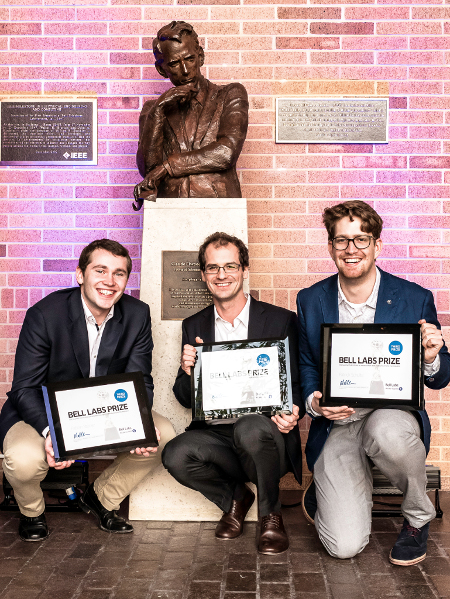
<p>Georg Böcherer, Fabian Steiner, and Patrick Schulte have won the third prize at the 2015 Bell Labs Prize! Our proposed Probabilistic Amplitude Shaping (PAS) is based on ideas we published in</p>

<ul>
  <li>G. Böcherer, F. Steiner, P. Schulte, <a href="http://dx.doi.org/10.1109/TCOMM.2015.2494016">Bandwidth Efficient and Rate-Matched Low-Density Parity-Check Coded Modulation</a>, IEEE Trans. Commun., vol. 63, no. 12, pp. 4651-4665, Dec. 2015.</li>
  <li>P. Schulte, G. Böcherer, <a href="http://dx.doi.org/10.1109/TIT.2015.2499181">Constant Composition Distribution Matching</a>, IEEE Trans. Inf. Theory, vol. 62, no. 1, pp. 430–434, Jan. 2016.</li>
</ul>

<h1 id="further-information">Further information</h1>

<ul>
  <li><a href="http://webdemo.inue.uni-stuttgart.de/webdemos/10_invited/RateXtransceiverDemonstrator/">PAS Webdemo</a></li>
  <li><a href="https://www.tum.de/en/about-tum/news/press-releases/short/article/33398/">press release field trial</a>.</li>
  <li><a href="https://www.tum.de/en/about-tum/news/press-releases/short/article/32802">press release Bell Labs Prize</a>.</li>
</ul>]]></content><author><name></name></author><summary type="html"><![CDATA[]]></summary></entry><entry><title type="html">Geometric Huffman Coding</title><link href="http://localhost:4000/ghc/" rel="alternate" type="text/html" title="Geometric Huffman Coding" /><published>2018-10-28T00:00:00+02:00</published><updated>2018-10-28T00:00:00+02:00</updated><id>http://localhost:4000/ghc</id><content type="html" xml:base="http://localhost:4000/ghc/"><![CDATA[<p>Dyadic probability mass functions (PMFs) can be generated by parsing a stream of independent equiprobable data bits by a full prefix-free code. Formally, \(p\) is dyadic if \(p_i=2^{-\ell_i}\), \(\ell_i \in\mathbb{N}\) and \(\sum_i 2^{-\ell_i}=1\). Such a PMF \(p\) is generated by a prefix-free code with codeword lengths \(\ell_i\). To match dyadic PMFs to communication channels, the Kullback-Leibler distance between the dyadic PMF and the capacity achieving PMF of the considered channel has to be minimized. See <a href="https://doi.org/10.1109/DCC.2011.10">Matching Dyadic Distributions to Channels</a> for details. On this web site I provide implementations of algorithms that find the optimal dyadic PMF.</p>

<h1 id="references">References</h1>

<ul>
  <li>G. Böcherer, PhD thesis, 2012, <a href="/capacityAchievingShaping.pdf">Capacity Achieving Probabilistic Shaping for Noisy and Noiseless Channels</a></li>
  <li>G. Böcherer, F. Altenbach, M. Malsbender, R. Mathar, <a href="https://doi.org/10.1109/ISWCS.2011.6125344">Writing on the Facade of RWTH ICT Cubes: Cost Constrained Geometric Huffman Coding</a>, best paper award ISWCS 2011, Aachen.</li>
  <li>G. Böcherer and R. Mathar, <a href="https://doi.org/10.1109/DCC.2011.10">Matching Dyadic Distributions to Channels</a>, presented at DCC 2011, Snowbird.</li>
</ul>

<h1 id="geometric-huffman-coding-ghc">Geometric Huffman Coding (GHC)</h1>

<p>Given is a vector \(x\) with non-negative entries. If additionally the entries sum up to one, than \(x\) is a PMF. The objective is to minimize</p>

\[\mathrm{D}(p\Vert x)=\sum_i p_i \log \frac{p_i}{x_i}\]

<p>subject to \(p\) is a dyadic PMF. Geometric Huffman Coding (GHC) finds the dyadic PMF \(p\) that minimizes \(\mathrm{D}(p\Vert x)\). GHC constructs a Huffman tree using the following updating rule. Denote by \(x_{m}\) and \(x_{m-1}\geq x_m\) the two smallest entries of \(x\). Then</p>

<p>\(x'=\begin{cases} x_{m-1},&amp;\text{if }x_{m-1}\geq 4x_m\\ 2\sqrt{x_{m-1}x_{m}},&amp;\text{if }x_{m-1}&lt;4x_m \end{cases}\).</p>

<p>For comparison, conventional Huffman coding finds the dyadic PMF \(p\) that minimizes \(\mathrm{D}(x\Vert p)\) (minimization is here over the second argument) by using the updating rule \(x' = x_{m-1}+x_m\).</p>

<p>ghc.m in <a href="/matching.tar">matching.tar</a> is a Matlab implementation of GHC.</p>

<h1 id="normalized-geometric-huffman-coding-nghc">Normalized Geometric Huffman Coding (nGHC)</h1>

<p>Given is a target vector \(x\) with non-negative entries and a weight vector \(w\) with strictly positive entries. The objective is to minimize the Kullback-Leibler distance \(\mathrm{D}(p\Vert x)\) normalized by the average weight \(w^Tp=\sum_i p_iw_i\), i.e., to minimize the fraction</p>

\[\frac{\mathrm{D}(p\Vert x)}{w^Tp}\]

<p>subject to \(p\) is a dyadic PMF. Normalized Geometric Huffman Coding (nGHC) iteratively finds the solution. nGHC supersedes the LEC Algorithm stated in <a href="https://doi.org/10.1109/DCC.2011.10">Matching Dyadic Distributions to Channels</a>.</p>

<p><code class="language-plaintext highlighter-rouge">nghc.m</code> in <a href="/matching.tar">matching.tar</a> is a Matlab implementation of nGHC.</p>

<h1 id="cost-constrained-geometric-huffman-coding-ccghc">Cost Constrained Geometric Huffman Coding (ccGHC)</h1>

<p>Given is a target vector \(x\) with non-negative entries and a weight vector \(w\) with strictly positive entries. The objective is to minimize the Kullback-Leibler distance \(\mathrm{D}(p\Vert x)\) subject to an average cost constraint \(w^Tp\leq E\) over all dyadic PMFs \(p\). Cost Constrained Geometric Huffman Coding (ccGHC) iteratively finds the solution.</p>

<p><code class="language-plaintext highlighter-rouge">ccghc.m</code> in <a href="/matching.tar">matching.tar</a> is a Matlab implementation of ccGHC.</p>

<h1 id="example-1">Example 1</h1>

<figure class="highlight"><pre><code class="language-matlabsession" data-lang="matlabsession">octave:11&gt; addpath /home/georg/matching
octave:12&gt; q = [0.328 0.32 0.22 0.11 0.022]';
octave:13&gt; pghc = ghc(q)
pghc =

   0.50000
   0.25000
   0.12500
   0.12500
   0.00000

octave:14&gt; phc = hc(q)
phc =

   0.25000
   0.25000
   0.25000
   0.12500
   0.12500

octave:15&gt; kldiv(pghc,q)
ans =  0.13619
octave:16&gt; kldiv(phc,q)
ans =  0.19548
octave:17&gt; phc_ = [hc(q(1:4));0]
phc_ =

   0.25000
   0.25000
   0.25000
   0.25000
   0.00000

octave:18&gt; kldiv(phc_,q)
ans =  0.15523
octave:19&gt;</code></pre></figure>

<h1 id="example-2">Example 2</h1>

<p><code class="language-plaintext highlighter-rouge">example2.m</code>:</p>

<figure class="highlight"><pre><code class="language-matlabsession" data-lang="matlabsession">w = (11:20)';
C = fsolve(@(s) sum(exp(-w*s))-1,1);
t = exp(-w*C);
d_nghc = nghc(t,w);
d_hc = hc(t);
R_nghc = -d_nghc'*log(d_nghc)/(w'*d_nghc);
R_hc = -d_hc'*log(d_hc)/(w'*d_hc);
disp(['codeword lengths of nghc: ' num2str(-log2(d_nghc'))]);
disp(['codeword lengths of hc  : ' num2str(-log2(d_hc'))]);
disp(['rate achieved by nghc:' num2str(R_nghc)]);
disp(['rate achieved by hc:  ' num2str(R_hc)]);</code></pre></figure>

<p>Output:</p>

<figure class="highlight"><pre><code class="language-matlabsession" data-lang="matlabsession">octave:7&gt; addpath /home/georg/matching
octave:7&gt; example2
codeword lengths of nghc: 3   3   3   3   3   3   4   4   4   4
codeword lengths of hc  : 2   3   3   3   3   4   4   4   5   5
rate achieved by nghc:0.15273
rate achieved by hc:  0.15265
octave:8&gt;</code></pre></figure>]]></content><author><name></name></author><summary type="html"><![CDATA[Dyadic probability mass functions (PMFs) can be generated by parsing a stream of independent equiprobable data bits by a full prefix-free code [...] (read complete post on website. Requires javascript to render math formulas correctly).]]></summary></entry><entry><title type="html">Half Huffman Coding</title><link href="http://localhost:4000/halfhc/" rel="alternate" type="text/html" title="Half Huffman Coding" /><published>2018-10-28T00:00:00+02:00</published><updated>2018-10-28T00:00:00+02:00</updated><id>http://localhost:4000/halfhc</id><content type="html" xml:base="http://localhost:4000/halfhc/"><![CDATA[<p>The ultimate objective of source coding is to transform the data into a sequence of 0s and 1s that is indistinguishable from a fair bit stream, i.e., a sequence of independent and identically distributed (iid) equiprobable bits. Accordingly, most work on channel coding starts with the assumption that the data to be transmitted comes as a fair bit stream. On this web site we provide an implementation of half Huffman coding (halfHC), an algorithm that finds optimal prefix-free source codes that produce 1s with a frequency close to 0.5.</p>

<h1 id="references">References</h1>

<ul>
  <li>F. Altenbach, G. Böcherer, R. Mathar, <a href="https://doi.org/10.1109/ICSPCS.2011.6140881">Short Huffman Codes Producing 1s Half of the Time</a>, presented at <a href="http://www.dspcs-witsp.com/icspcs_2011/">ICSPCS 2011</a>, Honolulu.</li>
</ul>

<h1 id="downloads">Downloads</h1>

<ul>
  <li><a href="/halfhc.tar">halfhc.tar</a>: implementation of halfHC. It is tested in Matlab R2010b. Having the Communications System Toolbox installed is advantageous. Having the Optimization Toolbox installed is partially required. <code class="language-plaintext highlighter-rouge">combn.m</code> is provided in halfhc.tar.</li>
  <li><a href="/Quotes.txt">Quotes.txt</a>: the short English text to test halfHC.</li>
</ul>]]></content><author><name></name></author><summary type="html"><![CDATA[The ultimate objective of source coding is to transform the data into a sequence of 0s and 1s that is indistinguishable from a fair bit stream, i.e., a sequence of independent and identically distributed (iid) equiprobable bits. Accordingly, most work on channel coding starts with the assumption that the data to be transmitted comes as a fair bit stream. On this web site we provide an implementation of half Huffman coding (halfHC), an algorithm that finds optimal prefix-free source codes that produce 1s with a frequency close to 0.5.]]></summary></entry><entry><title type="html">ICT-Cubes RWTH Aachen</title><link href="http://localhost:4000/ict-cubes/" rel="alternate" type="text/html" title="ICT-Cubes RWTH Aachen" /><published>2018-10-28T00:00:00+02:00</published><updated>2018-10-28T00:00:00+02:00</updated><id>http://localhost:4000/ict-cubes</id><content type="html" xml:base="http://localhost:4000/ict-cubes/"><![CDATA[<p>We developed a webservice to decode the facades of the ICT-Cubes, the new buildings of the electrical engineering faculty at the RWTH Aachen University.</p>

<h1 id="press">Press</h1>

<ul>
  <li><a href="http://www.aachener-zeitung.de/lokales/aachen/ict-cubes-rohbau-ist-fertiggestellt-1.691050">Aachener Zeitung: ICT-Cubes: Rohbau ist fertiggestellt</a></li>
  <li><a href="http://www.aachener-nachrichten.de/lokales/aachen/zwei-wuerfel-im-gruenen-fuer-wissenschaftler-1.531002">Aachener Nachrichten: Zwei Würfel im Grünen für Wissenschaftler</a></li>
  <li><a href="http://www.rwth-aachen.de/go/id/dlzu/?lidx=1aaaaaaaaaaadlzv">RWTH Aachen: Spatenstich zum Neubau der ICT-Cubes</a></li>
</ul>

<h1 id="talks">Talks</h1>

<ul>
  <li><a href="/ict-cubes.pdf">ICT Cubes Decode Webservice: From Slat Sequences to Cleartext</a></li>
  <li><a href="/ai.pdf">Writing on the Facade of RWTH ICT Cubes</a></li>
  <li><a href="/arc-slides.pdf">Writing on the Facade of RWTH ICT Cubes: Cost Constrained Geometric Huffman Coding</a></li>
</ul>

<h1 id="references">References</h1>

<ul>
  <li>Sebastian Baur, Bachelorarbeit, TUM, <a href="/baur2013ict.pdf">ICT-Cubes Decode Webservice: Von Lamellensequenzen zu Klartext</a>.</li>
  <li>G. Böcherer, Fabian Altenbach, Martina Malsbender, and Rudolf Mathar, <a href="https://doi.org/10.1109/ISWCS.2011.6125344">Writing on the Facade of RWTH ICT Cubes: Cost Constrained Geometric Huffman Coding</a>, best paper award at ISWCS 2011, Aachen.</li>
  <li>Fabian Altenbach, Georg Böcherer, and Rudolf Mathar, <a href="https://doi.org/10.1109/ICSPCS.2011.6140881">Short Huffman Codes Producing 1s Half of the Time</a>, presented at <a href="http://www.dspcs-witsp.com/icspcs_2011/">ICSPCS 2011</a>, Honolulu.</li>
  <li><a href="http://www.kadawittfeldarchitektur.de/projekte/projekt-aktion/show/projekt-titel/ict-cubes.html">kadawittfeldarchitektur: ICT Cubes</a></li>
</ul>

<h1 id="webservice">Webservice</h1>

<p>Our webservice allows to decode any slat sequence fragment. The fragment needs to be provided as a string that consists of l (left slat), r (right slat), and m (middle slat). Example:</p>

<p><a href="http://ict-cubes.appspot.com/?slats=rmrlrrrrmmrmllrrmrlrmrrrlrrrrlmllmlllrlrlrrlrllrrrmrmrrllrrmrlmlmmrlrmrlrrrmrrllrrlrrlmmr">ict-cubes.appspot.com/?slats=rmrlrrrrmmrmllrrmrlrmrrrlrrrrlmllmlllrlrlrrlrllrrrmrmrrllrrmrlmlmmrlrmrlrrrmrrllrrlrrlmmr</a></p>

<p>You can copy any fragment of the complete slat sequence below and append it to <a href="http://ict-cubes.appspot.com/?slats=">ict-cubes.appspot.com/?slats=</a> and let our webservice decode it.</p>

<textarea cols="100" rows="45" style="word-wrap:break-word;">
rmrlrrrrmmrmllrrmrlrmrrrlrrrrlmllmlllrlrlrrlrllrrrmrmrrllrrmrlmlmmrlrmrlrrrmrrllrrlrrlmmrlrrllmmmrrrlrlmrrmlmrmrrrrrmmmllrlllrmrlmllrlmrrlmmrlrrrrrlrrrmmmrrllmlmllrlrrmlllmrrmlmlrmrlllmrlllmrrllmlrrlrllllmrrrmlllmlrrmrrlmrmmlmmmlmrllrlrrlrlmllrlmrmllmmlrrrmlrrrlllmrrlllrrlrrlmmrrrmmmllllmrrmmrmmmmlrrrmllrmrrlrlmrrrrlrmllmllrrllllllmmrmrrrlmlmllmrlmrrrrllrllrrrllrllrmlrrllmlrrmlmrmllrrrlllllllmlrrmrrlmrmmlllmrrmrrrmmlllrmllmlrlmrlrlllllmrrmmmrrrmlmmmmrlrmrmrrlllrrmmmlrmmmrrllmlllllrlrrrrrlrrrlrlmrlrrrlrrrrlrlrrlmlmmmlrlmmllrrmrllllllrllmlrrmrrmllrrmlrllmmrmrlmrrlmllrmllrlrrllrrrllrmlrrlmlmlrlmrlrlrrllllmrrlmrrlrmrllrmlrlrrlrmlrrmmmllllmrrmmrmmmmlrrrmllrrrllllrmlrrmllrrlrrrmrmrrlllmlmrrllmrmllrrrlllrmrrrlrrmrrrrlrlrmrllllmrlmrrrmlllllrlmlrlllrmllmllrrlrrrllrlrlrmrrrlrrrrlmrlrrllrrlrmrllmmlrmmmrrllmmmlllllrmmrrlrllrrrrrmlmllmllrrrlrrlmrmrrlmmlmrlrlrrlrllrrllrlllrlrlmmmrmrrlrmrrrlrrrrlmlmlllrrmrrllrrlmmrrmrlrmrlrrlmrrrlrlrrlmmlrmrrlrlrrllmrllrmmlllrrrrrlmllrmrrrlrrrrllmllrlrlrlrmlmrlrlllrlllmrrlmmmrrrlrrmlrlllmrllllrrlrlllrmrlmllmlrrmlmrrrrlrrrrrrmmmlmrllrlrrlrlmlllllrmlrrmrmlrrrrlmlllrrlrrlmlllrlmrrrmlrrmrmlrrrrlmmmlrrrmrrllrlmrmrrmrlrrllrmrmlmmmmlllllrllllrllrllrrrlrrlrmlmrrllmllrmllrmllrrrllllmrlrrlrrmrlrrrllllmlrrlllmrrrrrmrrllrrlrrlmrmllrrrlllmllrrlllmrrrlrmrlrmmlrrrmlmrrrrlrlllrrrrrlrlrrlrlllrrrlllmllrrlllmrrrlrmrlllmrrmlllmrrrrrmrrllrrlrrlmrmllrrrllllmrlrrlrrmrlrrrlllmllrrrmlmrrrrlrllrrlrlrmlmlllmrrllmrrrrrmrlllrrrrrrmrlrlrrlmmrrmlrmlrmlrmmlrrrmmrllmrlrrlrmrlmlmlllrrlllrlmrlrrrlmlrllrrrrrrrrlllmlrrlmlrmmllrllllllmrrrlrmrrlrrrlrmmrrrrmrlrmrlllllmlmrrlllrmrrrrlmllrmrrrlrrrrllrmlrlmrrmrrlmlmrrmrmrlrrrllllrmlrrlrlrrlrmrllllmrrllmrmrrrmllrlmlmlrllmlrlrrlmmrlrrrllrmmrllrlrmmrlmllrmlmlrlllmrlmrrrllllmrlrrlrlrrrmrlmlllmrrllmlllllrlrrrrrlrrrlrlmrlrrrlrrrrlrllrrrlmmmmrlmrlrrllmrrmmrrllllllmrrlrllmrrrllrrrrrmrlrlmllrmllrrrllllllrllrmrlrrlmllllmrllmlrrlllrlrrrmlrlrmrllmmrrrlrrrrlllmrrmmllmlmrrmllrrlrmmllrmmmlllllrmmlrrrlllllmmrrmmllmrrlmrllmrrrlmmlllllrlrmrlrrllrlmmlmrlmlrmlrrrllrlrrrrrmmmllrlllrmrlmllrlmrrlmmllmrmmllmlrrmrlmmmrmrrlmmlrmlrllrlrmlrrrmlrmrmrmlmmllrmllmrlrmlrlrlllrrrrrlrmrllmmmrmlrlrrmrrmrrlrrrrrrmlrllrlrlrrrrmmmrrllmmlrmrrlllmrrlllllmllrlllmmrlrrrlllmmrrrmrrrrlrllrlllrmllrmllllrrrlmrmmmlrrrrlrllrlrllllmrrlmrrlrmrllmmrlrmrlmmrrllmrmlrmrmllrmllrmllrrlrrrrrmrmllmllmrrmllrmrrlrlrrrrlrmllmllrlrllmlllrlrrlrlrmlmlrmrrmrrmmlmrlmlrrrrrlrmrrrmllmmrmmmrmrrrmmlrrrrlmlmmmrrlmrlmllmrmlllmlrrmllllmrrmrrlmrrmmrlmlmrrlmlrllrrrrrrrrlllrmrrlmlrlrlrrlrrlrllmrrrlmlmmrrrmrrlllmlmlllmrrllmlmrrrrllrmllllrrrlrrlmlrrrrmlrmlrllmmrrllrmllrrllrrmmlmrmllrrmllmllmlrrlrrrllrrrlmrmlmrrlrllrllmrmrlrmrlllrrrlmrrlrlrrmmmlmrrlmrmlmrrlrllrllmrmlmlrlmmrrmrllllmrrrlllmllllrrrrrrlmrlrrlllmrlrlmrmrllrrrmmrrlmrlmrrlrrrlllrrrrlmmrlmrmlrlllrllrlrrmrmllmrrrrlrllrrlrlllrrrlllrmlrrlmlrrrrrmllllllrlllllrmlllrllllrmlllllmllrmmlrlrlrllrrrrmrmlrrrrlmlllmrrllmrrmlmllrllrrlrlllrlllmrrllmlrrlllmrrlrrrrmrrrrmrmrlrmmlrrlrrrrrrrmrrmrrlrlmrrlrmmlrllrrlmrrlmmrrrrllrrmrlmlrmmlrrrrlmrmlllmlllrrllrrlmlrrlrrlllllrrlrrrllrlrmmmlrmrllrllrmlrlllrmllrrlmrllrmrmrrmmmlrlrlmlrmlrlrlrrrlrlmrmllrmrlllrrlmlrlrllrrrllrllrmrrlrmrlrmrmlmmrllllmrrllrlllrmrrrlrrmrrmllrlmmmrrrlrlrrmrlmmrrrllrllrmrllllllmmrrrlrrlmmlmlrllrmrmrlmlrrlrrlllrrrlrrlrmlmrrrmmrlrmllmlmmmlmrlllmlrlrllmllrllrlmrllmllrrllrmmrrrrlrllllrllllmmlrmrrlmrrrlmlrmrmlmmmmllllllmrrmllrmrrlmrrmmrlrmrrrrlllrrlrllmmmlrlmlrllrrlrrrllrmrrlrlmrrrrlrrmlmrrlmlllrmlrrrllrllmlmrllllrmrrlrllmrrrllrrmrlmllrlrlrllrmrrlrrllmllrmrlrllrrllrrrlmrmrrlllllmmrrrlllrlmlmlllrlrlrrrllrmrlmlrmmmmmrrlllllmrlrrlmrmrllmrrrrlrmrrrrllllmmrlllllrrrrrmlllllrlrlmrrrrlmlrmrrllllrllmmmlrrrmrmlmrrllllmrmrllllrrllrmrmrlrmrrrlrrrrllllrmllllrrlmrrrrlmrrmlrrlmllllrrlmrllrlrrrmmlrmllrlrrllrrrlmmllllrlmmmrrlmrrrlrllllrlllrlmrllmrmllllrmrrlrllrllrmrmllmllrrmrrrrlllrrrllrllllrlllrllllrllllrllrllrrrlrrlmllmrlllllrmrrrlrrrrlrmllllrrlrllllmlrrlrrmrrmrrrrlllrrllmlllrmmlllmmrrmrllllllrlllllrrlrlmlrrmmlmrllmrrrrrmllrlrrlrlrrrrrmlrlllrrllrlmlrrlllrrllllmrrmlllrlrllmlrrrrrlllllrrrrllrrrmmmrllmlllrmrrrllllrlmrmrrllrmlrrrmlrmlllrmmrmrmlrmmllrmmrllmrlrrlmlrlrllrrlllrrllllmrrllmmlmlrlmmrlrrrllllmrllrrrrlrmlmrrrrlrmrllllmrrllmmllmmlrllrllmlllllrlllrllmmrlrrlmrlrmrrrrmrlmrlmlrmmrrrmmmrmrrrrmlmrlrrlrllmrrlrmrrrlrrrrllllllrmrrrmrrrllrmrlrrlmmlrllrlrrlrrllrmllmllrmmllrmrlrrlrllmlllrrrllllllrllrmlmmllrlrlrllrllrmmmlllrrrrrllrrrrlrmrlmrlmlrmlrrrmmlrlrllrlrlrllrmrmrlmllrmrmllrrrrmrrrrmrmrlllmrlrrmrrrmllmmrrmrlrrrlrmrmmllmmrrrlrrlmrmllrr
</textarea>]]></content><author><name></name></author><summary type="html"><![CDATA[We developed a webservice to decode the facades of the ICT-Cubes, the new buildings of the electrical engineering faculty at the RWTH Aachen University.]]></summary></entry><entry><title type="html">Publications</title><link href="http://localhost:4000/publications/" rel="alternate" type="text/html" title="Publications" /><published>2018-10-28T00:00:00+02:00</published><updated>2018-10-28T00:00:00+02:00</updated><id>http://localhost:4000/publications</id><content type="html" xml:base="http://localhost:4000/publications/"><![CDATA[<p>Below a selected list of publications. For a more complete list, see <a href="https://scholar.google.de/citations?user=d9_KU3YAAAAJ">google scholar</a>. I provide <a href="/talks">slides of selected talks</a> on a separate page.</p>

<h1 id="preprints">Preprints</h1>
<ul>
  <li>G. Böcherer, <a href="https://arxiv.org/abs/1707.01134">Achievable Rates for Probabilistic Shaping</a>.</li>
</ul>

<h1 id="thesis">Thesis</h1>
<ul>
  <li>Habilitation thesis, 2018, <a href="/bocherer2018principles.pdf">Principles of Coded Modulation</a>.</li>
  <li>PhD thesis, 2012, <a href="/capacityAchievingShaping.pdf">Capacity Achieving Probabilistic Shaping for Noisy and Noiseless Channels</a>.</li>
  <li>Master’s thesis, 2007, <a href="/analyticAsymptotics.pdf">Analytic Asymptotics of Discrete Noiseless Channels</a>.</li>
</ul>

<h1 id="selected-papers">Selected Papers</h1>

<ul>
  <li>
    <p>G Böcherer, P Schulte, F Steiner, <a href="https://ieeexplore.ieee.org/document/8627924">Probabilistic Shaping and Forward Error Correction for Fiber-Optic Communication Systems</a>, J. Lightw. Technol., vol. 37, no. 2, pp. 230–244, Jan. 2019.</p>
  </li>
  <li>
    <p>F Steiner, P Schulte, G Böcherer, <a href="https://doi.org/10.1109/CISS.2018.8362291">Approaching waterfilling capacity of parallel channels by higher order modulation and probabilistic amplitude shaping</a>, 52nd Annual Conference on Information Sciences and Systems (CISS), 2018.</p>
  </li>
  <li>
    <p>G. Böcherer, Tobias Prinz, Peihong Yuan, Fabian Steiner, <a href="https://doi.org/10.1109/WCNCW.2017.7919039">Efficient Polar Code Construction for Higher-Order Modulation</a>, presented at WCNC 2017.</p>
  </li>
  <li>
    <p>F. Steiner, G. Böcherer, <a href="https://ieeexplore.ieee.org/document/7937997">Comparison of Geometric and Probabilistic Shaping with Application to ATSC 3.0</a>, presented at SCC 2017.</p>
  </li>
  <li>
    <p>F. Buchali, F. Steiner, G. Böcherer, L. Schmalen, P. Schulte, W. Idler, <a href="http://dx.doi.org/10.1109/JLT.2015.2510034">Rate Adaptation and Reach Increase by Probabilistically Shaped 64-QAM: An Experimental Demonstration</a>, J. Lightw. Technol., vol. 34, no. 7, 2016.</p>
  </li>
  <li>
    <p>G. Böcherer, B. C. Geiger, <a href="http://dx.doi.org/10.1109/TIT.2016.2610433">Optimal Quantization for Distribution Synthesis</a>, IEEE Trans. Inf. Theory, vol. 62, no. 11, pp. 6162-6172, 2016.</p>
  </li>
  <li>
    <p>F. Steiner, G. Böcherer, G. Liva, <a href="http://dx.doi.org/10.1109/JSAC.2015.2504298">Protograph-Based LDPC Code Design for Shaped Bit-Metric Decoding</a>, IEEE J. Sel. Areas Commun., vol. 34, no. 2, pp. 397-407, 2016.</p>
  </li>
  <li>
    <p>P. Schulte, G. Böcherer, <a href="http://dx.doi.org/10.1109/TIT.2015.2499181">Constant Composition Distribution Matching</a>, IEEE Trans. Inf. Theory, vol. 62, no. 1, 2016.</p>
  </li>
  <li>
    <p>G. Böcherer, F. Steiner, P. Schulte, <a href="http://dx.doi.org/10.1109/TCOMM.2015.2494016">Bandwidth Efficient and Rate-Matched Low-Density Parity-Check Coded Modulation</a>, IEEE Trans. Commun., vol. 63, no. 12, pp. 4651-4665, 2015.</p>
  </li>
  <li>
    <p>G. Böcherer, <a href="http://dx.doi.org/10.1109/LCOMM.2014.2337318">Labeling Non-Square QAM Constellations for One-Dimensional Bit-Metric Decoding</a>, IEEE Commun. Lett., vol. 18, no. 9, pp. 1515-1518, 2014.</p>
  </li>
  <li>
    <p>G. Böcherer and R. A. Amjad, <a href="https://doi.org/10.1109/ISIT.2014.6874818">Informational Divergence and Entropy Rate on Rooted Trees with Probabilities</a>, presented at ISIT 2014.</p>
  </li>
  <li>
    <p>R. A. Amjad and G. Böcherer, <a href="https://doi.org/10.1109/ISIT.2013.6620479">Fixed-to-Variable Length Distribution Matching</a>, presented at ISIT 2013.</p>
  </li>
  <li>
    <p>G. Böcherer and R. Mathar, <a href="https://doi.org/10.1109/ITW.2011.6089473">Operating LDPC Codes with Zero Shaping Gap</a>, presented at ITW 2011, Paraty</p>
  </li>
  <li>
    <p>G. Böcherer and R. Mathar, <a href="https://doi.org/10.1109/DCC.2011.10">Matching Dyadic Distributions to Channels</a>, presented at DCC 2011, Snowbird.</p>
  </li>
  <li>
    <p>G. Böcherer, V.C. da Rocha Jr., C. Pimentel, and R. Mathar, <a href="https://ieeexplore.ieee.org/document/5447136">On the Capacity of Constrained Systems</a>, presented at SCC 2010, Siegen.</p>
  </li>
</ul>]]></content><author><name></name></author><summary type="html"><![CDATA[Below a selected list of publications. For a more complete list, see google scholar. I provide slides of selected talks on a separate page.]]></summary></entry></feed>